
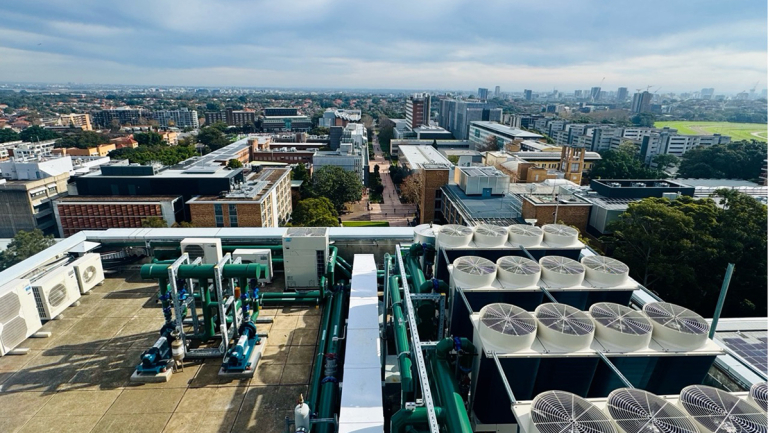
UNSW has been recognised in a sustainability industry discussion paper for our proactive approach to refrigerant risk management, an often overlooked but increasingly critical issue in sustainable building design and operations.
What are refrigerants?
Refrigerants are substances used in heating, ventilation, air conditioning and refrigeration systems to transfer heat. They’re essential for thermal comfort and air quality control inside modern buildings.
Why refrigerants matter
If not managed carefully, refrigerants pose serious environmental and health risks. Some have thousands of times the global warming potential of carbon dioxide, while others may be flammable. Some refrigerants are PFAS or can degrade into PFAS – so-called ‘forever chemicals’ that persist in the environment and may pose health risks to occupants and natural ecosystems.
The Freeze Frame: Refrigerants as Long-Term Building Infrastructure paper, released by the Green Building Council of Australia (GBCA) and Australian Institute of Refrigeration, Air Conditioning and Heating (AIRAH), highlights UNSW’s leadership in addressing these risks and setting best practice for refrigerant stewardship.
UNSW’s precautionary approach
As part of UNSW’s electrification strategy, Estate Management developed a refrigerant hierarchy in 2023. It guides project teams, consultants and contractors in selecting refrigerants that align with long-term sustainability goals. It’s based on the Planetary Boundaries framework, which considers global risks like climate change and ozone depletion and local risks like flammability, toxicity and pollution from synthetic chemicals (PFAS).
The hierarchy is used across campus projects and is continuously updated to reflect emerging technologies and risks. It prioritises refrigerants with ultra-low global warming potential, zero ozone depletion potential and no PFAS, while also factoring in availability.
“Although the precise risks of PFAS are still emerging, we believe in taking a precautionary approach. Our refrigerant hierarchy helps us make informed, future-ready choices,” said Jose Bilbao, UNSW’s Senior Manager, Energy and Utilities.
Leader in sustainable building practices
UNSW’s inclusion in the paper places us alongside other national leaders such as Lendlease and the Northern Territory Government, reinforcing our role as a leader in sustainable building practices.
This recognition reflects UNSW’s commitment to sustainability, innovation and responsible asset management. It’s another step towards building a climate-resilient future for our campuses and communities.